Why Website Foundations Matter for Long Term Growth for Sydney Businesses
What’s in this article
- A website serves as the central hub of a business’s digital marketing and must support lead generation, credibility, and conversions to drive long-term success.
- Strong website foundations include clear strategy, technical structure, design usability, content quality, and ongoing optimisation to support sustainable growth.
- Poor foundational elements harm credibility, reduce conversions, and hinder search visibility over time.
- Defining purpose, audience, and measurable goals upfront ensures the website aligns with business objectives and future needs.
Your website is the foundation of your digital marketing strategy. As the central hub of your online operations, it supports conversion and lead generation, builds credibility and trust, and empowers your customers to use your products and services.
Regrettably, many businesses in Sydney outgrow their websites too quickly due to poor planning and execution, outdated technology, and a lack of forward-thinking. Strong website foundations prevent these outcomes, significantly improve user experience, and drive long-term growth and success.
If your website hasn’t met your expectations, there’s no need to be discouraged. This blog explains the basics of website foundations, empowering you to unlock your site’s full potential and propel your business forward.
What Are Website Foundations?
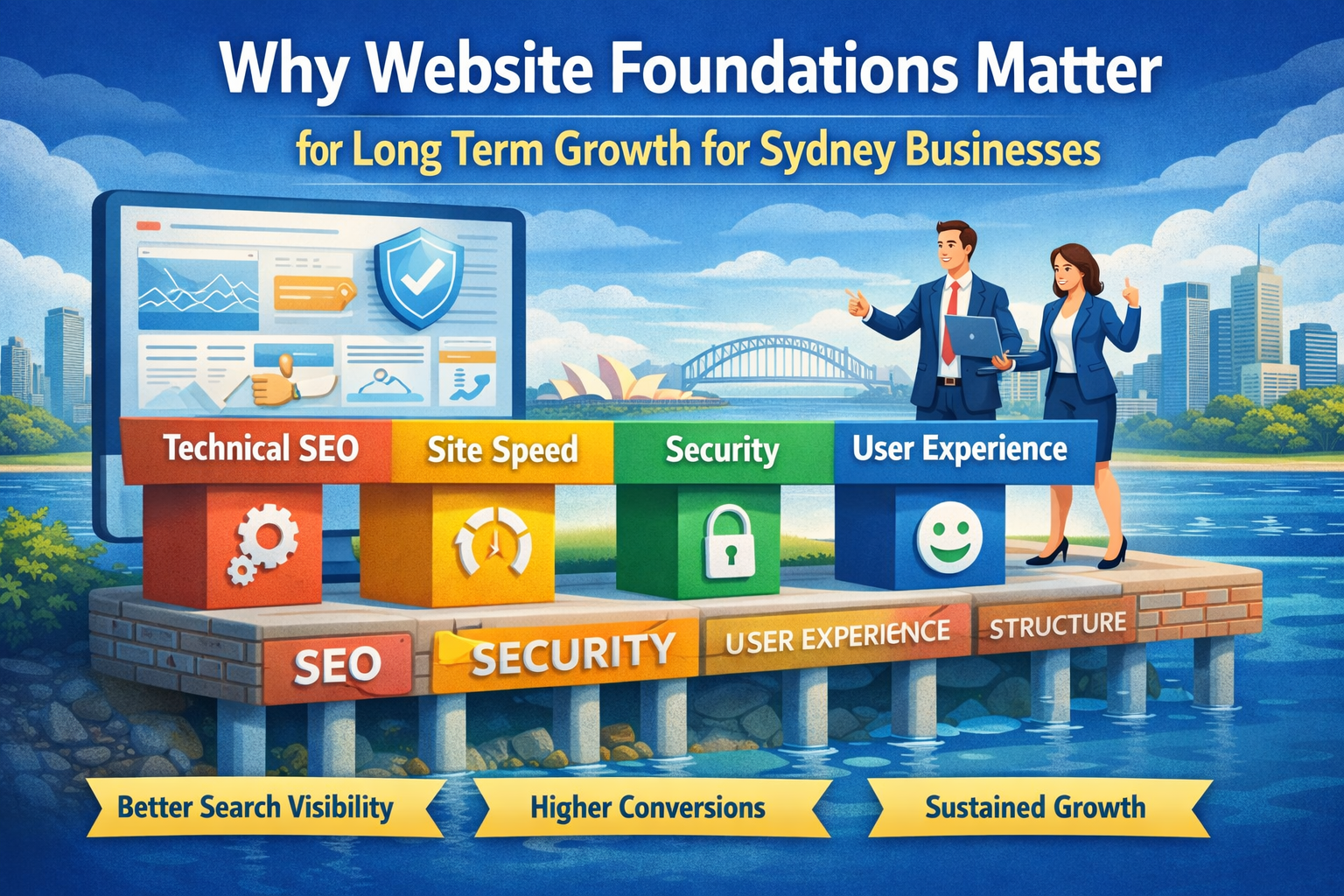
Website foundations are the essential, structural, and strategic elements that ensure a website’s optimal functionality and security. The core website foundations include:
- Core technical components: These include your website’s domain name, hosting, and SSL certificate — part of the wider technical SEO picture.
- Strategy and structure: Strong website foundations clearly indicate why the site exists (e.g. e-commerce, lead generation, blogging, etc.), and SMART (Specific, Measurable, Achievable, Relevant, Time-bound) goals. They’re also user-oriented, showing a thorough understanding of the target audience and tailoring the content accordingly.
- Design and usability: Professional web development in Sydney optimises a design that automatically adjusts to various devices, such as laptops, desktops, and mobile phones. They also use innovative menus that enable users to find information easily and a visual hierarchy (colour, size, contrast, and white space) to allow the user to view important information.
- Content and SEO: Efficient websites constantly upload useful, relevant information that resonated deeply with their intended users. Web development in Sydney enables optimal search engine optimisation (SEO), improving your website’s ranking and visibility on Google and propelling business growth.
- Performance and security: This foundation focuses on a website’s speed, security, and privacy compliance, ensuring the user’s convenience and peace of mind.
How Poor Foundations Impact Business Growth
Poor website foundations negatively impact business performance in several ways:
- Brand credibility: An obsolete, inefficient website can compromise your brand credibility. Users expect a well-polished, refined website that reflects the company’s values. Unfortunately, a poorly-designed website conveys a lack of professionalism and attention to detail, driving potential customers away.
- Direct financial consequences: High bounce rates can lead to lost opportunities for engagement and profit and repeat business. These factors can negatively impact an organisation’s finances over time. Strong CTAs are one of the simplest ways to address this.
- SEO rankings and search visibility: An efficient website design can hurt your SEO rankings and search visibility. Broken links, outdated content, a shortage of backlinks, and poor URL structures compromise your organisation’s visibility on Google.
You can avoid these pitfalls by implementing best website foundation practices through a reputable website design and development team that can improve user experience and drive long-term business growth.
Key Elements of a Strong Website Foundation
Whether you’re considering a website design or rebuild or looking to make a wise, long-term investment rather than a quick refresh, we recommend that your website features these five essential elements for long-term success:
- Purpose and strategy: Clarity is often the essential starting point of professional web development in Sydney. Defining specific, measurable goals, determining your target audience, and reviewing competitors’ highlights can help you achieve this goal and set the tone for a fundamentally-sound, professional website.
- User experience and design: Emphasis on Intuitive navigation, mobile-first design, visual hierarchy, readability, and accessibility elevate the user experience and transform your website’s aesthetics and appeal.
- Performance and security: Savvy website development in Sydney emphasises performance and security, building user trust and business credibility. These professionals upgrade speed page optimisation, hosting, protocols, regular backups, updates, and web application firewall (WAF) to help achieve these goals.
- Content and SEO: Fresh, relevant, and informative content drives people to your website while SEO helps them locate it in search engine results.
- Analytics, maintenance, and growth: Your website’s long-term success depends on meticulous, ongoing monitoring and maintenance to fix issues and continue improvement. Metrics (bounce rate, average session time, and conversion rate, A/B testing and optimisation, regular audits, and scalability features enable your website to become successful in the long run.
Website Rebuild vs. Redesign: Choosing the Better Strategy for Your Business
Understanding the difference between a website redesign and rebuild enables business owners in Sydney to choose the appropriate strategy for their site, enhancing the user experience and promoting long-term business growth. See our full breakdown of redesign vs rebuild for a deeper look.
- Website redesign: This strategy involves modernising a website’s look and feel, while retaining its fundamental features. Professional website developers can transform outdated websites through eye-catching graphics or enhanced layouts, making them more appealing to their intended audiences.
A website design can improve customer communication, stay current with the latest design trends, improve user experience, broaden organisational reach, and showcase new products or services.
We recommend redesigning your website in the following scenarios:
- Reduced sales, leads, or conversion rates.
- Lack of visual appeal.
- Inability to accommodate mobile users.
- Poor, inconsistent SEO rankings and visibility.
- Issues uploading new content.
- Website rebuild: This strategy significantly transcends updating or enhancing a website’s look and feel—it impacts the site’s core technology, functionalities, security, compliance, scalability, credibility, SEO, and conversion rates. A website rebuild is usually an overhaul rather than a mere visual refresh.
A timely website rebuild often improves user experience, page speed, and responsiveness. Consider this option when your website can no longer support your website marketing strategy. For instance, an outdated website based on HTML code cannot support modern content management systems (CMS). Hence, it requires a website rebuild.
Need help with your website?
At Heart Digital, our team have extensive experience designing, building and optimising websites to help local business grow and succeed online. Get in touch to discuss how we can help you.
The Risks of Cutting Corners in Web Development
Web development covers visual redesigns or full website rebuilds , depending on business needs. Regardless of your preferred strategy, cutting corners in web development poses serious risks, including:
- Security breaches: Overlooking security measures leaves websites vulnerable to hacking, malware, and phishing attacks, leading to serious legal or financial repercussions.
- Poor user experience: Unresponsive designs, slow page speeds, and technical issues can discourage users, reducing conversion rates, sales, and repeat business.
- SEO and brand damage: Haphazardly developed websites lower search engine rankings and visibility and tarnish brand reputations.
- Operational issues: Insufficient testing often leads to system failures and downtimes that compromise business operations.
Future-Proofing Your Website for Growth
Your website is the foundation of digital marketing because it is the central hub where your online strategies connect and convert. An efficient website builds credibility and trust, supports conversion and lead generation, allows tracking and insights, and provides business owners with complete control over every aspect of their brands.
Unfortunately, many businesses in Sydney outgrow their websites too quickly due to limited initial planning, evolving business needs, inferior technology, mediocre SEO features, outdated design trends, and a lack of future-proofing.
As a business owner, you can prevent these scenarios through a highly skilled, experienced web development contractor in Sydney, who can design or rebuild your website with mobile responsiveness, integrations, and scalability in mind. Since an efficient website requires forward-thinking, future-proofing your website for growth is the catalyst to long-term business success.
Empower Your Website for Peak Performance
Laying strong foundations enables your website to achieve peak performance in the long run. A site with exceptional technicalities, strategy, structure, design, user features, security, and SEO components engages customers, protects brand credibility, upholds professionalism, and drives long-term business growth.
Redesigning or rebuilding your website can propel your business to the next level. Invest in timely, cost-effective website design and development and SEO services to transform your website into a high-performance platform and enjoy robust, long-term business outcomes.
FAQs
Why do website foundations matter for business growth?
Website foundations matter because your site is the central hub of your digital marketing. It supports lead generation, conversions, credibility, trust, and customer access to your products or services. When a website is poorly planned or built on outdated technology, it can limit growth and create problems as the business changes. Strong foundations help improve user experience, support search visibility, and give your website the structure it needs to keep performing over time. For Sydney businesses, this means planning beyond how the site looks and focusing on how it works, converts, and scales.
What are the main foundations of a strong website?
A strong website foundation includes technical setup, strategy, structure, design, usability, content, SEO, performance, and security. Technical elements include your domain name, hosting, and SSL certificate. Strategy covers the website’s purpose, target audience, and measurable goals. Design and usability help people move through the site easily across desktop and mobile devices. Content and SEO help users find useful information while supporting visibility in search results. Performance and security also matter because speed, privacy, backups, and protection all affect trust and user experience. These elements work together to support long-term website performance.
How can poor website foundations affect a business?
Poor website foundations can damage credibility, reduce conversions, and limit search visibility. An outdated or poorly designed site can make a business look less professional, which may cause potential customers to leave. Slow pages, broken links, weak structure, outdated content, and poor user experience can also increase bounce rates and reduce enquiries or sales. The page explains that these issues can create direct financial consequences over time. Poor foundations also make it harder for search engines to understand and rank the website, so the business may lose visibility to competitors with stronger sites.
Should a business choose a website redesign or a rebuild?
The right choice depends on what is holding the website back. A redesign mainly updates the look and feel while keeping the core structure and features. It can help if the site looks dated, struggles with mobile users, has lower conversions, or needs a more appealing layout. A rebuild goes deeper and changes the website’s core technology, functionality, security, compliance, scalability, SEO, and conversion setup. It is better when the current website can no longer support the business’s marketing strategy or future needs. A rebuild is usually a full overhaul rather than a visual refresh.
Why is future-proofing important in website development?
Future-proofing is important because businesses can quickly outgrow websites that were built without long-term planning. As business needs change, a website may need to support new content, integrations, mobile use, SEO requirements, scalability, and better user experiences. The page explains that limited planning, outdated technology, weak SEO features, and old design trends can cause websites to fall behind. Future-proofed development considers where the business is going, not only what it needs today. This helps the website remain useful, secure, flexible, and easier to improve as marketing goals and customer expectations change.
Articles
Related Articles
We’re passionate about our work and the industry in which we work. We therefore regularly public
digital marketing updates for the benefits of our clients and the broader public.